In the very end, civilizations perish
because they listen to their politicians
and not to their poets.
— Jonas Mekas
You and a Poem
You and a Poem
Let’s start with a bit of orientation: these thoughts are not about poetry collectively. They’re about poems individually. There’s an important difference between poetry in general and poems standing alone that’s too often overlooked in writing, reading, evaluating, and teaching them. Poetry is a literary genre that specializes in a wide variety of emotive language patterns, sentence structures, and expressions of thought. Such a definition is intentionally vague because poetry encompasses such a huge mass of writing and speaking that to be more specific would unavoidably exclude much work that many people would classify as poetic. There’s nothing, however, that is general, wide-ranging, or non-specific about an individual poem. A particular poem nails it. While poetry is a collective noun meant to cover a gazillion forms, sizes, and methodologies, single poems are unique and concrete examples that stand proudly (and the best of them, defiantly) alone and aloof from all general academic dogma and dicta. While discussions about poetry may be bland, discussions about a specific poem likely will not be.
Considerable effort is made in the classroom to interest students in poetry, but the fact remains most people come to poems on their own . . . usually stumbling across a lovable poem in some book, or as children listening to their parents reading aloud to them. And those youngsters who become poets most often hunt down poem after poem on their own time, delving into each poem’s haunting metaphysical aspects and puzzling out how a careful weaving of words, sounds, rhythms, and sentence structure creates music-less song as it imprints itself on the budding poet’s welcoming imagination. Children are predisposed to respond to poems and innately understand what a poem does, how it does it, and why. They may not be able to explain it all technically, but they feel it, they like it, and given time, gentle guidance, and some teaching magic, they will crave poems for the rest of their lives and prosper. These few remarks are my attempt to explain to adults how a poem works, knowledge already inherent in children . . . unless it’s bludgeoned out of them in a classroom.
Like love, poems are simple and stay simple until we complicate matters unnecessarily and our devotion goes off track and we lose perspective, lose interest, and turn away. Don’t let that happen to you. Love openly (or secretly if you must). Love wholeheartedly, open-heartedly, erotically (or chastely if you must), and love with total commitment no matter the consequences. Love a poem in exactly the same way.
A poem is an anticipated pleasure before it’s anything else. Then it’s a fun ride afloat on words. And then it’s feeling slightly different inside when you’ve finished. And if it’s a really good poem, you’ll say, “Wow!” And if it’s a great poem, you’ll say “Whoa!”
What a Poem Does
Archibald MacLeish said it best when he concluded his poem, “Ars Poetica,” with the lines, “A poem should not mean / But be.” The poem . . . sitting there with all of its words carefully given their perfect placement by their author, the various lengths of its lines carefully gauged to their best effect, its punctuation (or lack of punctuation) ready to be as helpful as possible . . . has the capacity to arouse emotions, stir thinking, cause or preclude actions, and change beliefs. But the poem itself does not “mean” anything. While the poet may have had an agenda, the poem does not, and while the poet may have had intentions, the poem has none of them. It may have a story to tell, but it is not fiction. It may have instruction to give, but it is not nonfiction. The poem, for better or worse, simply is.
Poetry is to language as music is to sound. Just as music gives elevated organization and intensified perspectives to otherwise common and superficial sounds, so poetry gives expansion and deeper meaning to otherwise pedestrian and utilitarian words. A poem can take two ordinary words a reader has encountered separately hundreds of times and, by juxtaposing them or by marking one as a modifier of the other, create an image previously unimagined by the reader. I immediately think of Homer’s vivid “wine-dark sea,” for example. Or Emily Dickinson calling lightning “an apparatus of the dark.” Or Richard Wilber closing his fabulous “Advice to a Prophet” with the shimmering lines:
Ask us, ask us whether with the worldless rose
Our hearts shall fail us; come demanding
Whether there shall be lofty or long standing
When the bronze annals of the oak-tree close.
And poetry has a toolbox as powerful and varied as any artist’s palette to heighten, deepen, and lighten our emotions and notions about life and the universe and what we have to do with anything and everything. All a reader of a poem has to do, like a hearer of a piece of music, is listen. The poem will do the rest, just as Robert Frost writes in his essay, “The Figure a Poem Makes,” that “like a piece of ice on a hot stove, the poem must ride on its own melting.” And that’s where you come in: you are the hot stove. Your experiences in life and the way you encountered the words used in the poem in other circumstances provide the heat that transforms the vocabulary of the poem into something personal for you. Undoubtedly, you’ve come across the word “gigantic” before in hundreds of prose places, but you’ve never felt its power until you’ve read it in the last line of Arkansas poet Bryan Borland’s poem written in the aftermath of his father’s sudden, violent death:
There’s no Arkansas football
on the downstairs television,
no last conversations, but everywhere
reminders of little, gigantic things.
When you lose someone you truly love, the little, gigantic things that daily bound the two of you are everywhere, little things like his old watchband worn for so many years, gigantic things like his old watchband that encircled his beloved wrist for too few years. Gigantic like your love, your ache, your loss, and “gigantic,” as massive as it always is, all in all, is now and forevermore too small a word to describe your grief. Bryan Borland’s poetic memoir Less Fortunate Pirates: Poems from the First year Without My Father rewards slow, meditative reading by giving common words and actions a quiet beauty that stays with the reader long after the book has been closed. And that’s the way it is with poetry: common words, unexpected words, phrasings with surprising twists and turns, rhymes that emphatically punctuate a thought, meters that float your attention to dramatic ends . . . or no ends at all. Poems increase your vocabulary not just by introducing you to new words, but by giving old words new meanings as you find them in unexpected expressions, new meanings as they rub up against each other in strange, unsettling, magical ways. For instance, take the lines from an Ellen Bass poem, “The Morning After,” in which she gently captures for the reader a glimpse of lovemaking:
Didn’t we shoulder
our way through the cleft in the rock of the everyday
and tear up the grass in the pasture of pleasure?
Look at the wonderful work those words do in their coming together! Common, bland words like “shoulder,” “cleft,” “rock,” “grass,” “pasture,” and “pleasure” jostle each other just for a moment to give the reader an opportunity to experience their enlightening union and maybe feel something that in all their existence in the English language those words will not combine to produce again. Poetry does that.
How to Behave in the Presence of a Poem
And there it is, right there in front of you: a poem. It’s on that page, that sheet of paper, looking back at you and seeing what you’re seeing: an unknown quantity . . . the unknown quantity that you are, that it is.
Forget everything else: the temperature of the room, the presence of superfluous people, the cacophonies of news media and other passing traffic, the dessert you haven’t yet eaten, your endless daily schedule, and chores still to be done. You may be in a classroom with other students, reading in bed with your spouse lying beside you, or simply killing time in a dentist’s office before your appointment, but you are suddenly there alone now . . . just you and this poem.
It's not a novel, or even a short story. Don’t treat it like one. That is, don’t hurry through it. It isn’t going to help you pass the time, provide you with temporary and superficial escapism, or vicarious pleasures of a harmless or sordid sort. Nor is it nonfiction; that is, explaining some issue, instructing you in assembling or repairing something, or persuading you about some truth.
Read it, don’t study it. Read it slowly and let it happen to you. Notice how some words are clumped together by similar sounds, how long each line is, how each line has its own thought worth pausing a moment to think about, how punctuation is or isn’t there, and how when you finish reading it, the poem just sits there looking back at you as if waiting for you to say something in response. And if you think you may have missed something, or if you’re a little confused, or if you really liked it, or if you really disliked it, it’s okay to read it again. The poem would like that, and then maybe you’ll have a different reaction with something to say.
By the way, you don’t need to know who the poet is. In fact, it’s probably better for your relationship with the poem if you don’t know. At least initially. When you’re better acquainted with the poem and understand better how you feel about it, there may be a place for knowing the author and seeing how that extraneous bit of information affects your feelings about the poem. It shouldn’t have any effect at all. When the poet stopped working on it and allowed the poem to be distributed, the poem shook free of all the writer’s detritus and was ready to be encountered by itself.
Let’s look at an example. Please read this:
O Western Wind when wilt thou blow
The small rain down can rain
Christ! my love were in my arms
and I in my bed again.
Now please read it again, slowly feeling the words and noticing their association with each other and what they do to the line in which they appear. As for me, I notice the capitalization of the poem’s opening words, “O Western Wind,” which seems to give them some importance. I also notice the old-fashioned phrasing, “wilt thou,” that seems to place us decades in the past. I see “small” rain as something other than a “regular” rain’s common soaking on a summer day, or a “large” rain such as a thunderstorm. Perhaps spring showers signaling the blessed end of winter and its sleet and snow? And then there’s that expletive, “Christ!” with its exclamation point. Maybe it indicates a narrator who’s frustrated and a bit downhearted at his or her situation. Or maybe it’s not an expletive at all, but rather a sincere cry to the Almighty? And the completion of the line makes me believe it’s a love poem, while the final line convinces me that it's definitely not about a platonic love! For me, the word “bed” is sudden and unexpected, becoming (for me) quite powerful, the most attention-getting word in the entire poem. It’s a good word on which to end everything. It gives clarity to what this narrator wants and his irritation at not being able to achieve it. I see the narrator shivering in the dark and cold looking out over a desolate landscape, perhaps away from home, certainly away from what really matters in life.
Is this what you see in the poem? Would you say the poem expresses sorrow? Angst? Eroticism? Can you see yourself in a similar frame of mind sitting at your desk at work or commuting to your office while watching January snow coming down and thinking of you and your spouse in happier days alone and young together in that cabin by the lake in New Hampshire’s White Mountains? Can you say, “God, will it ever be so again? Please!”
Is this what the poet intended? I have no idea. No one does. This poem (or fragment of a poem) has been around at least since the 17th Century, and the poet is unknown. But the beauty and pleasure of this poem is contained within itself and is not one bit diminished by not knowing a single thing about the poet.
Okay. Let’s look at another short poem:
River Snow
A thousand mountains and not a bird flying
ten thousand paths and not a single footprint
an old man in his raincoat in a solitary boat
fishes alone in the freezing river snow
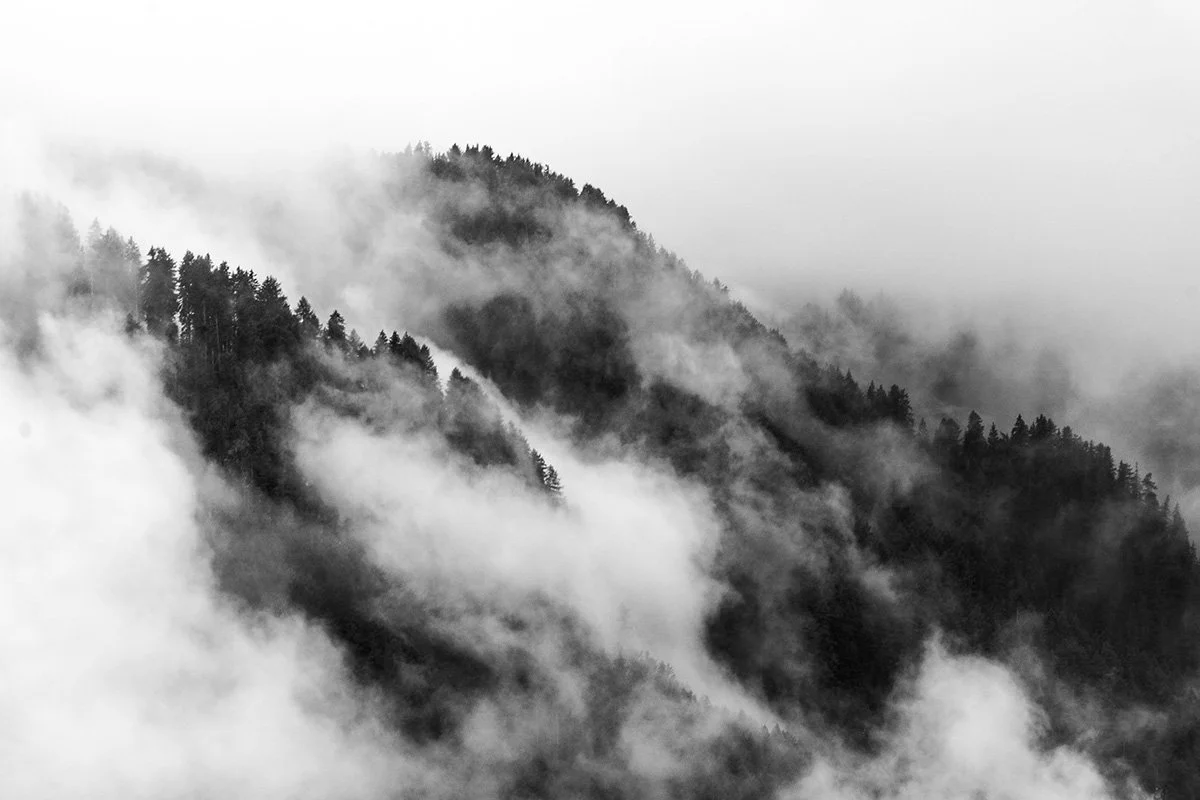
Once again, please read it two or three times slowly, noticing little things such as how the key words balance, with one at each line’s beginning and another at the end: mountains / bird, paths / footprint, old man / boat, and fishes / snow. Notice the total lack of punctuation. And we’re dealing with a thousand mountains, not just one . . . ten thousand paths, not just one. And he’s an “old” man, not just at any age. Alone. And it’s freezing. On a river. In the snow. Is his raincoat doing him any good? I don’t think so physically, but perhaps it provides some mental comfort. And what is he doing? He’s alone, very alone, in his old age’s lousy weather, but he’s fishing, still fishing in this late season, this late in his life. What is he fishing for? Will he catch anything? I don’t know, but I don’t think so. And for me, that’s the point: He’s alone in an empty world, old in a hostile environment on the river of life, and yet he’s still getting by, still “fishing” for whatever as everything freezes and descends. And will this be true for all of us as we tackle the terrain of old age?
Anyway, that’s what this poem says to me, perhaps holding a mirror up to my face so that I see my elderly self in it, hopefully still fishing in a cold world as I write these words. But what does it say to you? As with all poems, there may be other explications that work for a majority of readers; there may have been some intention by the poet to express something else, but in the end, the sense of the poem is the sense that works for you, the sense that you find in it for yourself. To be honest, you don’t need extraneous information to feel and enjoy this poem.
But if extraneous material will add to your pleasure (remember, it won’t add anything to the poem itself), let’s have some. The poet is one of China’s finest, Liu Tsung-yuan. He wrote it about twelve hundred years ago, and he’s considered a “nature” poet with many of his existing 146 poems dealing with planting and caring for crops, flowers, shrubs, and trees through various seasons. He led an active life in politics and the political dramas of the Chinese emperor’s court, being both promoted to high office and banished. Could this poem reflect his feelings about himself in a late chapter of his life? Maybe. Maybe not. The poem is obviously a translation, and I trust the integrity of the translator (Red Pine) to have captured the skeleton, musculature, and viscera of the original in creating the new body of this English version. One reason I really like this poem is that it causes me to reflect about myself and my own feelings in relation the world. Can any poem do better than that?
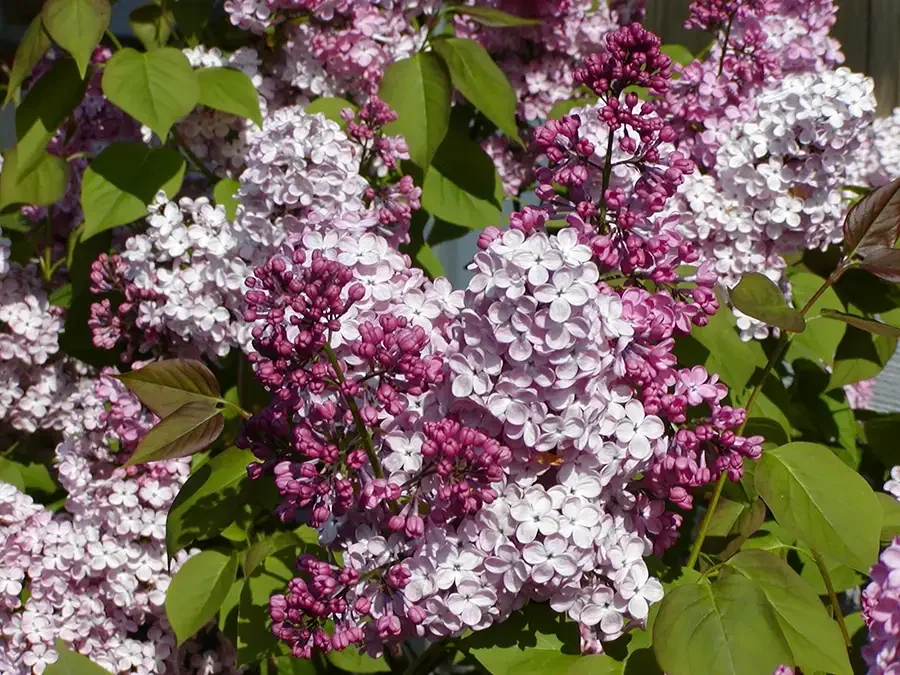
Now let’s examine two longer poems, both titled “Lilacs.” Both poems praise the shrub, but from very different perspectives and with very different purposes.
Lilacs
Lilacs,
False blue,
White,
Purple,
Colour of lilac,
Your great puffs of flowers
Are everywhere in this my New England.
Among your heart-shaped leaves
Orange orioles hop like music-box birds and sing
Their little weak soft songs;
In the crooks of your branches
The bright eyes of song sparrows sitting on spotted eggs
Peer restlessly through the light and shadow
Of all Springs.
Lilacs in dooryards
Holding quiet conversations with an early moon;
Lilacs watching a deserted house
Settling sideways into the grass of an old road;
Lilacs, wind-beaten, staggering under a lopsided shock of bloom
Above a cellar dug into a hill.
You are everywhere.
You were everywhere.
You tapped the window when the preacher preached his sermon,
And ran along the road beside the boy going to school.
You stood by pasture-bars to give the cows good milking,
You persuaded the housewife that her dish pan was of silver.
And her husband an image of pure gold.
You flaunted the fragrance of your blossoms
Through the wide doors of Custom Houses—
You, and sandal-wood, and tea,
Charging the noses of quill-driving clerks
When a ship was in from China.
You called to them: “Goose-quill men, goose-quill men,
May is a month for flitting.”
Until they writhed on their high stools
And wrote poetry on their letter-sheets behind the propped-up ledgers.
Paradoxical New England clerks,
Writing inventories in ledgers, reading the “Song of Solomon” at night,
So many verses before bed-time,
Because it was the Bible.
The dead fed you
Amid the slant stones of graveyards.
Pale ghosts who planted you
Came in the night-time
And let their thin hair blow through your clustered stems.
You are of the green sea,
And of the stone hills which reach a long distance.
You are of elm-shaded streets with little shops where they sell kites and marbles,
You are of great parks where everyone walks and nobody is at home.
You cover the blind sides of greenhouses
And lean over the top to say a hurry-word through the glass
To your friends, the grapes, inside.
Lilacs,
False blue,
White,
Purple,
Colour of lilac,
You have forgotten your Eastern origin,
The veiled women with eyes like panthers,
The swollen, aggressive turbans of jewelled Pashas.
Now you are a very decent flower,
A reticent flower,
A curiously clear-cut, candid flower,
Standing beside clean doorways,
Friendly to a house-cat and a pair of spectacles,
Making poetry out of a bit of moonlight
And a hundred or two sharp blossoms.
Maine knows you,
Has for years and years;
New Hampshire knows you,
And Massachusetts
And Vermont.
Cape Cod starts you along the beaches to Rhode Island;
Connecticut takes you from a river to the sea.
You are brighter than apples,
Sweeter than tulips,
You are the great flood of our souls
Bursting above the leaf-shapes of our hearts,
You are the smell of all Summers,
The love of wives and children,
The recollection of the gardens of little children,
You are State Houses and Charters
And the familiar treading of the foot to and fro on a road it knows.
May is lilac here in New England,
May is a thrush singing “Sun up!” on a tip-top ash-tree,
May is white clouds behind pine-trees
Puffed out and marching upon a blue sky.
May is green as no other,
May is much sun through small leaves,
May is soft earth,
And apple-blossoms,
And windows open to a south wind.
May is full light wind of lilac
From Canada to Narragansett Bay.
Lilacs,
False blue, White,
Purple,
Colour of lilac.
Heart-leaves of lilac all over New England,
Roots of lilac under all the soil of New England,
Lilac in me because I am New England,
Because my roots are in it,
Because my leaves are of it,
Because my flowers are of it,
Because it is my country
And I speak to it of itself
And sing of it with my own voice
Since certainly it is mine.
This first poem is highly descriptive and filled with sharp, clear imagery of New England wildlife and landscapes. I notice that the poem speaks directly to the lilac plant itself, addressing it as “you” and “your,” and the metaphors (both stated and implied) connecting the shrub to all aspects of country life in New England are strong: lilacs are spring, lilacs are the month of May, lilacs are ever-present youth and future promise, and lilacs are New England in lovely and loving flower. I like the positive, upbeat tone of the poem, with its closing intimation of the speaker’s oneness with and possession of the lilac. The fact that I was born and raised in northern New England and saw firsthand its lilacs cultivated in home gardens as well as feral lilacs growing in forest glades probably doesn’t hurt my reaction to the poem. I enjoy the poet’s affectionate romp through New England with its vivid images and obvious pride in belonging to this place.
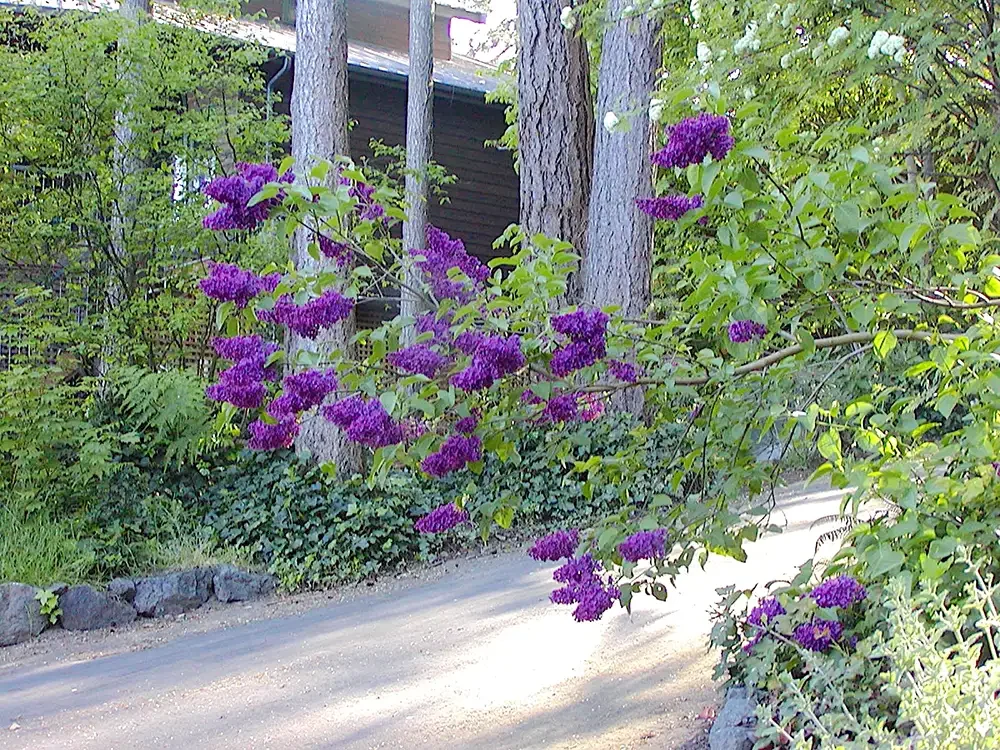
Now read this second “lilac” poem:
Lilacs
You are brighter than apples,
Sweeter than tulips,
You are the great flood of our souls . . . .
— Amy Lowell
Down in the garden, lilacs have overtaken tame roses
and pay insistent tribute to the war dead of New England
and resist cultivation that values heroes less than appeasers.
Warriors who were heroes once will be heroes again,
and the fragrance of their valor stirs unyielding hearts
that beat for freedom.
Down by the river, lilacs have smothered weak dogwood
and salute in purple and blue the war dead of New England
and defy all negation that would build monuments no more.
Warriors fell once in glory; in glory, they’ll rise again,
and the green of their sacrifice urges the free to stay free.
Down in the village, lilacs have shouldered aside meek privet
and cry remembrance from their wind-tossed leaves
for the war dead of New England
and cry praise from their heart-shaped leaves for those
who answered the call to fight and die.
Warriors fought when few dared; they would fight again,
seeds of their resolve growing new generations who stay free.
Down in stony-cold churchyards, above on the granite hills,
tossing in windswept fields and seaswept coastlines, by homes
and highways, by the walks of universities, universally
lilacs remember the war dead of New England.
Patriot and pilgrim, they died for liberty; for liberty, they’d die again,
and the branches and roots of their spirit entwine you all
whether you know it or not and bind you fast to your freedom.
My reading of this second poem finds that while it has the same title as the first, it has very different subject matter: war. War, and patriotic defense of home. But it does not focus its praise on veterans who fought and returned to their families and businesses, the lives that were theirs before battle. No, this second lilac poem honors those killed in action, honors those who are, in every sense of the word, now free. They were free before they went to war, and whatever the outcome of the battles, they shall remain free and pass on that legacy of fighting for liberty to succeeding generations, and in that sense, they were destined to be heroes and will be heroes again in the spirits of those who follow and fight for their freedom again. As an interesting side note, the common lilac (Syringa vulgaris) is the state flower of New Hampshire, a state with a small population that provided three regiments that fought in the American Revolution’s Battle of Bunker Hill, Bennington, and Saratoga, leaving about 420 soldiers dead on the field and far more wounded. I also notice the lilacs are contrasted with “tame roses,” “weak dogwood,” and “meek privet.” Could these shrubs be stand-ins for groups of people seen as “appeasers” or those unwilling to sacrifice anything in the cause of liberty? The rhythm of the first poem is personal, even intimate, but the rhythm of this second poem establishes a pace that is assertive, march-like, even aggressive, as if subtly defending itself against the charge of being overly patriotic. And I can safely say that this second poem builds on the first, using lines from the first poem as an introductory epigraph.
The two poems stand alone before you. You read them as they are, read them without interference from critics, instructors, or others who would “help” you to understand them. They speak to each other, and you may find significant similarities in them along with a love of lilacs and New England. The fact that the poet of the second poem uses lines from the first as an epigraph seems to urge a comparison between the two. Poets linking their poems to the work of other poets is often found in literature going all the way back to the Ancient Chinese poets who often enjoyed contests in which they would write poems using each other’s exact rhyming words in the exact order of their appearance in new poems. The second lilac poem seems to indicate that the lilac is a kind of national flower, much like Austria’s edelweiss that has come to symbolize purity devotion, patriotism, and resolve. Although the national flower of the United States of America is the rose, New England certainly embraces the lilac as its regional icon.
Like most poems, these two seem to encourage re-reading. In going over both poems a second time or more, or in re-reading them after some time as passed, our attention may be drawn to images and poetic techniques we missed the first time around in much the same way a piece of music heard a second time can call one’s attention to rhythms and phrasings we hadn’t appreciated before.
And now to the poets, if you insist. Once again, I call your attention to your personal, unobstructed relationship to the poem. That’s the one that counts. While knowing something about the writers may be interesting, informative, surprising, or even unsettling, such knowledge should not be allowed to warp the significance you found for yourself in the poems themselves. They are what they are regardless of their origins, and it is up to you to make them your own.
The first lilac poem was written by Amy Lowell and appeared in her 1925 Pulitzer Prize for Poetry book, What’s O’Clock. Poet and literary critic Louis Untermeyer said that, of all her work, “Lilacs” was the poem he liked best. Do you like the poem more now that you know it has been critically acclaimed? Lowell was a pioneer and strong advocate of poetry’s Imagist Movement in the United States, a movement that emphasizes vivid imagery and free verse to enhance descriptions and discussions of common, mundane occurrences and scenes in everyday life and to give them a gloss of importance they deserve. Does knowing this fact affect your appreciation of “Lilacs”? Lowell was short in stature, overweight due to a glandular condition, wore a pince-nez, smoked cigars, and is reputed to have been a lesbian. Does any of this personal (even private) information change your interpretation of “Lilacs”? Although the Imagist Movement had a significant impact on modern American poetry that can still be seen today in contemporary poems, Lowell’s reputation as a poet declined after her death in 1925; in fact, a volume of her collected works wasn’t published until 1955. Today, she’s acknowledged to have been influential in reforming American poetry of the early 20th Century, but currently her poems are largely considered old-fashioned period pieces. Does this bit of information lower your estimation of “Lilacs”? And finally, here is another imagist poem by Lowell:
The Taxi
When I go away from you
The world beats dead
Like a slackened drum.
I call out for you against the jutted stars
And shout into the ridges of the wind.
Streets coming fast,
One after the other,
Wedge you away from me,
And the lamps of the city prick my eyes
So that I can no longer see your face.
Why should I leave you,
To wound myself upon the sharp edges of the night?
Now you’ve read a second poem by the same author. Does this second poem in any way modify your opinion or understanding of the first? Is your answer to all five questions above “No”?
And now about that second lilac poem: I wrote it. Does that fact do anything to it? No?
Good. I think you’re ready to meet and greet more poems that are also ready to be met and greeted by you!
How to Teach a Poem
When I was a young officer-instructor teaching English at the United States Naval Academy, I had a memorable confrontation with a midshipman who was more than frustrated by my lectures on poetry. He had endured my explications of poems by T. S. Eliot, Conrad Aiken, and Wallace Stevens, and I had endured his eye-rolling, grimacing, and slumping in his seat. But when in discussing a poet’s use of extended metaphor I said that Robert Frost’s venerable poem, “After Apple-Picking,” was a monologue about the end of life and dying, that did it. “Where do you get this stuff?” he blurted out. “The guy’s talking about harvesting apples! He’s got an apple orchard, and it was hard work with long hours, and he’s glad it’s done! The words are clear. The lines are smooth. The images he describes are bright and solid. How in hell does this death crap fit into any of it? You’re forcing stuff into it that Frost didn’t put there! If he’d meant to write about death, he was a good enough writer to say so! That’s why I like prose. It says what it means.” I let him finish, then calmly condescended with, “Frost reaches beyond an obvious, dark metaphysical discussion of death by giving the reader an ordinary farmer’s chore to explain how the end comes and we’re ultimately ready for it. This poem is a little like a candle lighting a dark place in the mind. And when the reader thinks about it for a while, that candle can become a star.” But the midshipman was having none of it: “See, that’s why poetry is the worst form of writing! A candle? More like one of those fireflies that rises over our parade ground! There’s no hidden meaning in that firefly’s light. Only an idiot would see it as a star!” Mercifully for both of us (and the class), a bell signaled the end of class. But the midshipman was, in fact, an excellent student majoring in mechanical engineering, and that evening, I wrote the poem below for him. When I gave it to him in our next class, he relaxed and laughed.
Fireflies Over Worden Field, United States Naval Academy
Essentially, all poetry comes to this:
The early lines are permapressed with meaning,
acrylic at times, at times natural fiber and bold –
early lines can tear upon a mind’s perusal,
tear after all into bright ribbons actually unfit for anything,
unfit strips of colors unlike the broad prose bolts so muted
that again and again say it all so well so many times over
and wear so well under abrasive eyes.
And the later lines of any poem
(the reader having gotten through the first of it all unscathed)
are simply bright bits of fabric on patterned rolls,
an unimportant image here and there badly frayed,
devoid in the end of meaning – nothing left
but garish color and rhythmic sounds by the time it’s over,
sounds that’ll go on onanating all night long,
or on and on as long as they’re allowed to go,
for poetry is the worst form of art,
keeping its readers relentlessly searching out sense
in the deep green darkness which is, after all,
all humans know of night, and little bits and bars
of senseless brilliance that flash in the midnight’s lines are,
after all, not light. No, they’re just a lower life’s luminescence
which fools mistake for stars.
I was inexperienced and ill-prepared to be teaching poetry. I didn’t really know what the hell I was doing, and it showed – to the detriment of all the poems I taught. But time passed. My own love of poems led me to examine the issue as to why I found so much solace and joy in poems while others did not. I understood the mechanics and cleverness poets used to excite a line, burnish and brandish an image, pound home a point, but that was all technique and set-up. It wasn’t the driving force behind the poem. I eventually, slowly, even laboriously came to see that the success of any poem wasn’t in the poem itself. It was in my response to it. It was in how it affected me personally, and those poems that mirrored me in their telling, that moved me emotionally, and that somehow changed my perspective on a topic and deepened my own understanding had subtly taught me about myself. Once I realized that, I was able to plumb the fellowship poets have with their attentive readers.
One fall, I taught a college class in the development of the modernist movement in early 20th Century American poetry. On the first day of class, the students wandered in and took their seats while noticing their stone-faced professor standing at the front of the room silently watching them. On every chair, I had placed a copy of that old war horse, “The Highwayman,” by Alfred Noyes, and each student picked up the poem, looked skeptically at it, and sat down. When everyone was seated, I cleared my throat and began my theatrical reciting of the poem, starting with those great opening lines,
The wind was a torrent of darkness among the gusty trees.
The moon was a ghostly galleon tossed upon cloudy seas.
And the highwayman came riding —
Riding — riding —
The highwayman came riding, up to the old inn-door.
The poem has 17 stanzas, and it had taken me a full two weeks to memorize it, nearly driving my officemate crazy with my constant repetition of the lines to get the tone, pauses, and word emphasis just right. But as I continued through the poem while cruising up and down the classroom aisles, gesturing appropriately and making eye contact with each student, I saw that I had their full attention. Some intensely followed my memorized recitation with the copies they had found on their chairs, while others simply watched me with astonished or fascinated expressions. Professors rarely see undergraduates sitting in their classes looking fascinated. As I slowly spoke the romantic (if tragic) closing two stanzas, I lowered my voice to a whisper and at the end just stopped. I stood silently in a silent room with every eye on me, and then I said, “’The Highwayman’ was published in 1906, but it just as well could have been published in 1806. It has all the trappings of traditionally structured romantic poems that were anathema to early 20th Century poets. They despised everything about the poem I’ve just recited, and now, ladies and gentlemen, we are going to do our very best to find out why.” And now after my rendition, they sincerely wanted to find out why. I had them!
And that’s the point: teaching a poem is simply connecting it to the students. Getting it “into” them. Helping them to sense the song it’s singing is the same song already inside them. Nudging them into an understanding that whatever it is that they’re feeling as they read the poem can’t be put into words, but instead must just be a secret between the poem and them, must just be a momentary connection between the words and them that stills life’s chaos for a split second before life’s daily madness rushes back and they move on. The poem must just be!
One does not “study” a poem any more than one “studies” one’s friends. You find shared connections with a friend, admire those connections, and feel better about yourself. That’s what friendship does. Reading a poem uncovers values and appreciations and principles within yourself that ordinarily lie quietly in your mind and character, and reading a poem brings them to your attention briefly as you remember a moment from your past, a promise you made to yourself, a favorite experience you shared, a rule by which you live, a dream you’ve had, a success, a failure, a regret, a deeper feeling, a grief. A poem speaks to you at first with language you understand, words whose definitions you know, and then it touches you in a way you hadn’t expected, lightly perhaps, secretly perhaps, and in a way you cannot put into words. Yes, some poems (maybe most poems) will not do this for you. Others may find them intriguing or moving, but you don’t. No problem. And some poem will come along unexpectedly and stop you in your tracks. You’ll stop cold. You’ll feel something different, wordless. You’ll read it again. And maybe a third time. And you’ll want to remember the title, the author, and where you can find it again because in this busy, confusing, take-no-prisoners world you’re shouldering your way through, you’ve just made a friend.
Prose can instruct you. It can guide you, change your perspective on things, cause you to rise up or sit down. A poem, on the other hand, can touch you in ways you can’t describe, in ways a lover does, in ways prose doesn’t allow, and you’re suddenly awake and aware.
No two people experience a poem in the same way, so teaching a poem to a class of twenty or thirty students is a fool’s errand. Sure, you can explain how the poem is put together, point out lines and phrasings that appeal to you personally, and put it in the context of the world today, but you must let people and help people to experience the poem for themselves. Ask rhetorical questions, such as: “How and why does this poem touch your personal values?” and “Who else in your life do you think would share your feelings about this poem, and why?”
Remember that teaching the mechanics of a poem (its rhyme scheme, use of metaphors, line structure, and employment of poetic devices) is the same as teaching the mechanics of a clarinet (its design, internal structure, and materials used to build it). In both cases, such technological information may be interesting, but the purpose of the poem and the clarinet is to create an emotional experience in someone that will be worthy of their time. That emotional experience and how it is achieved is what deserves our focus in a classroom.
How to Write a Poem
No one can tell you how to write a poem. Believe me. Oh, people can tell you how to write poetry, but not how to write a particular poem. When you take a creative writing class in poetry, the instructor will immerse you in poetic jargon, writing prompts, literary criticism, and writing workshops where you will sweat over other people’s writings and become insecure about your own. At the end of the class, you’ll receive a grade or an evaluation of some sort, and you’ll know how to develop extended metaphors, apply assonance and rhythm to a poetic line, and use all kinds of poetic devices. You’ll know a great deal about writing poetry in general, but when it comes to writing a specific poem, you’ll still be on your own. And that’s a good thing!
No one can tell you how to write a poem. Only you yourself, alone in the chilly chaos of your own mind, alone in the unstable good will of your own heart, alone in your unbelievably fragile thoughts, can perform the necessary tortuous mental gymnastics and hijinks that will eventually create your poem. Some people listen to music while they write and revise. Ohers, like William Wordsworth, go for long walks while they compose lines and then hurry home to write them down. Still others, like Wordsworth’s friend Samuel Taylor Coleridge, drink alcohol “to get in the right frame of mind.” Whatever. Don’t waste too much time on the settings and trappings of where, when, or how you write. Instead, focus on your thoughts, your vocabulary, your phrasings, what your words do in different combinations, how they create different rhythms, sounds, and visual patterns on a page. Focus on where the poem is coming from, and then focus on where it’s going. Focus on the emptiness you’re filling with something. Focus!
Some poetry plays strict attention to meter, rhyme schemes, and stanza patterns, while much contemporary American poetry does not and is often termed “free” verse; “free,” I guess, because writers of such verse are “freed” from many of the traditional mechanics of poetry to wend and wander their way at will using language structured like prose in their efforts to tame a thought or snag a metaphor. Some people today (although the number is dwindling) would agree with Robert Frost’s famous pronouncement that writing free verse is like playing tennis without a net.
It's certainly okay to ask someone else about word choices, effectiveness of a particular line or image, or their impression of how you’re developing the subject. But always keep in mind that person doesn’t have your experiences in life, your perspectives on living, your understanding of the world, or even knowledge of your vocabulary and the connotations each word has for you based on your experiences with it. Bottom line: you can ask for advice, but ultimately, the poem is solely your responsibility. Writing a poem is a lonely business, and you need to keep it that way. Don’t even think of collaboration with editors, publishers, or professors of this and that. Don’t consider which topics are fashionable or unfashionable, popular or unpopular, or overdone or underdone. In the act of creation, editors and audiences are your enemy. It may be a cliché, but it’s true: avoid them like the plague. Once you’ve finished a poem, or at least decided to stop working on it and let it go, then it’s safe to bring others back into your life.
So now you’ve come to the end. It’s written. You’ve checked every punctuation mark, even taken out and put back in the same comma several times and switched between a semicolon and a period too many times. And finally, you’ve read the poem aloud listening to the music of its vocabulary, the rhythm of its lines, and the pauses that place emphasis where emphasis should be. You’ve even read the poem again at different times of the day, perhaps in the kitchen in the morning, outdoors somewhere quiet at noon, in a dimly lit hallway in the evening, and finally in your bed late at night. Maybe you’ve changed a couple words or taken a few words out altogether and you're satisfied with this final product. Well, before you give it to the world (which could mean just one other person or the unknown masses on some website), there’s one last step to take. Put the poem away. Place it in a desk drawer under a book or on a closet shelf under some clothes or in a dark cubbyhole where only dust gathers, and then leave it there for at least a week without disturbing it. Let it rest and ripen or rust. This is the acid test for a poem. The excitement you felt in writing it will go away during this time it sits unmolested, and when you come to it again you’ll be approaching it with a fresh perspective somewhat resembling that of an average reader. After you’ve retrieved it and read it once more, and after you’ve corrected that typo you missed even after proofreading it six thousand times, one of three things will result:
You’ll realize this isn’t your best work, be glad you didn’t send it out for publication, and throw it away while accepting that it was time well spent honing your craft.
You’ll find lines in the poem that merit expansion, delete the rest, and start working on it again.
You’ll smile to yourself as you decide this is a damn good poem, ready to see the world.
Whichever of the three results you face (and understand that the third one is by far the rarest), get on with it.
Poets I admire have one thing in common despite enormous differences in their cultures, perspectives, philosophies, and styles: as they work, they all ignore potential audiences, readers, editors, publishers, and critics; they ignore what is legal and illegal, socially or politically acceptable or unacceptable, right or wrong, good or wicked; they throw themselves wholeheartedly and bodily into the only thing that matters: the poem . . . the Poem . . . the POEM!
Can a Poem Be Illegal?
Yes. But that won’t stop a poet from writing it. There was a time when poets worldwide wrote dangerously. Some important ancient Chinese poets paid with their careers in government, while others lost their lives. In the 20th Century, radical poets had to flee the Soviet Union when their work fell into disfavor and their arrests became imminent. And in the 21st Century in the United States, teachers in both public and private schools must pay attention to laws being passed forbidding certain themes and words in the classroom, thus making a host of poets way off limits for presentation and discussion. Poets as varied in their cultures and subject matter as Ovid, Chaucer, Shakespeare, Baudelaire, Walt Whitman, Gwendolyn Brooks, Mahmoud Darwish, Allen Ginsberg, and Federico Garcia Lorca have had their poetry banned.
What have been the principal sources of banning poems? That is to say, banning expressions of thought? Traditionally, religions (particularly monotheistic ones) have been bastions of hatred against any thinking that differs from their approved doctrines and dogma, and here in the 21st Century we see just how emphatic and open such hostility to diverse thinking can be when a particular religion becomes dominant and merges with a political force. The Russian Orthodox Church has evolved into a powerful tool for the ruling class, merging its doctrines with those of the current Russian government, and to express thoughts contrary to those approved by the church/government can lead to charges, not just of heresy, but now of treason with long prison sentences. In some countries where Islam is dominant, there is no daylight between their autocratic governments and their religious dicta, and official “morality” police keep close watch over what is written and take quick action whenever that writing is interpreted to run counter to current church/government views. Their censorship doesn’t just eliminate forbidden thoughts; it can and does cost writers their lives.
In the United States, we can detect signs of religion coupling with government to enforce religious doctrines that otherwise couldn’t achieve the force of law. In the early 21st Century, some Christian sects have become politically aware and active with their members either contributing financially to religious-minded politicians or running for political office themselves. Some religious societies have managed to place their devotees in the legal system as prosecutors and judges where they can ensure secular laws are correctly interpreted to favor religious dogma and continue religious-based discriminations approved by their clergy. Numerous politicians make political hay by claiming the founders of the United States and the creators of its constitution intended the country to be a Christian nation, when in fact the Founding Fathers had the exact opposite in mind. They saw religion’s dangers to many kinds of freedom and worked hard to ensure the nation’s government and laws would be secular. How successfully the country will remain secular remains to be determined because powerful forces are working diligently and relentlessly for change.
But the biggest source of trouble for free-thinking and diverse writing is ourselves. We refuse to read material that we suspect does not support our prejudices, that tries to persuade us to change our perspectives or to dissuade us from lessening our biases. Don’t feel bad about yourself, though. Even today, controversial speakers espousing points of view from all over the intellectual spectrum are being shouted down in university auditoriums and banned from speaking to college classes. This is all the more ironic because the essence of the educational experience is to teach students to think. It’s only by the friction of ideas that we can generate heat to warm our lives and eventually light by which to see life from many valid perspectives. The clash of ideas is noise to the ignorant, but it’s the music of multiple existences to the wise.
And too often we find the press and social media excluding perfectly valid minority opinions from being published in their pages. Whether it’s from fear of losing advertising revenue, subscribers, or financial backers, journals, newspapers, and websites often exclude articles and opinion pieces from unpopular or minority sources that might present a challenge for the political, philosophical, or cultural status quo.
But the most insidious banning of thought occurs at an even more personal level: self-censorship.
Before a religion, a government, or a journal has a chance to ban an idea or point of view, we ourselves do the odious work for them by refusing to entertain a perspective on a controversial subject, often refusing to research and explore it, let alone write about it. One or two offending phrases or words are sufficient to close our minds and end our pursuit of truth using the scientific method and logical reasoning. We close ourselves within our personal belief cocoons without examining the opposing argument’s evidence to see if we might find facts, truths, or potential for the maturing and growth of our own perspectives.
And this is where poets come in. The only “banning” or censorship of a topic should be done by the poets themselves, and it should even then only be done after careful evaluation. Bad, sad reasons for not pursuing a topic as the subject of a poem include the fear someone important won’t like it, the subject is too culturally “sensitive,” or many people may find it offensive, shocking, or unpatriotic. I’ve stopped at listing three reasons, but the list is very long and I’m sure you can add to it yourself.
As Elizabeth Sargent writes in her poem, “We Poets,”
We poets always hope our poems may bring love;
Everything we want is against the law.
There are many, many fine poets out there doing wonderful and exhilarating things with language. Hunt for them. Your exploration will reward you, deepen you, and maybe even wake up parts of you that you didn’t know were asleep.
It’s my fervent belief that every poem, regardless of its writer, subject matter, or style, says to its reader, “Hey! Look here! Look at what I do, and how I do it! What do you think of that? Maybe you should reread me to see if you feel something more, understand something more about me and yourself. And what about the poet who wrote me and his or her intentions? Forget the poet. Forget intentions. This is just about me and you and our relationship.”

Let me conclude my thoughts about poetry with a poem of my own. Thank you for your time!
Art of Poetry
Mirror myself back to me unawares, bald-face and bare,
letting the emperor without clothes see what heretofore
everybody in his rueful, tenuous, unholy kingdom knows.
Tell me indirectly, metaphorically, symbolically, in fits
and starts, every word parsed to hell and back, how poetry
fears nothing, dares blasphemy, most rageous of the arts.
Let me meet myself, come to pause a moment where
this word or that suggests my soul. Allude as you will
to my inner store of private matter unalluded to before.
Entice my wandering attention back to myself obliquely,
to my earliest belief. Intrude on my attitude to bring me
in clear language back to sensibilities since lost to grief.
Untrap with tuneful verbs loves hemmed by caution,
loves bought dearly when a child. Unwrap loves adulthood
taught me to bind to be never, ever brought to mind.
Let me with naked nouns run wild. Let them, unsought,
play with me adventurously, their spirits breathing upon
my obstreperous, erotic clay, their fever mine if hell to pay.
Astound me galore, the top of my head taken off, no fire
so bold as to ever warm me, no hope in your ocean of
words of my reaching propriety’s old, dependable shore.
Tap lost joy. Let adjectives make nouns loud. Let adverbs
toy with actions, braking and accelerating verbs to match
the flow of my emotions, a profound insight in the making.
I read you for an introspection offered in my naïve tongue.
I hear in you a retrospection of a sound my childhood loves
had sung. I want you as life’s laurel wreaths to lie among.
Raise up in me an old rankling need, a sly psychological
angling to have once again a child’s power to hold close
fun-abundant time without concern for the day or hour.
Turn dank things to thoughts that bring the warm and dry.
I want to see again loves I’ve lived among take a spin
about me once more, I, who never bade loves goodbye.
A line or half a line, a phrase, a caesura, a rhyme, may
they ignite recall, my subconscious firing up the ghost
of all I believed in adolescence, now true again for a time.
Be a benediction. Bless me, caress me, possess me, most
ethereal of arts, hardest to endure, easiest to profane, and
inoculate my faith against the power of dogma and its pain.
To others, be a mundane verse or song, but be balm to me
as I react with “Whoa!” to the psalm I’ve stumbled on,
a stream of consciousness to others, but to me a cataract.
Coin a phrase. Coin a thought. Telescope, microscope
wisdom, a divine trait. Bring me by myself to myself.
Please let me find myself, come to myself, early or late.
Let my take on eternity seem real. And when I read you,
hear you, it’s ever the touch of humanity I want to feel,
you being an aphrodisiac to arouse and carouse and heal.